Posted on : 06-01-2026
As a leading manufacturer of printing rubber rollers serving India, Africa, and Asia, we at [Your Company Name] understand the critical role inking rollers play in offset printing. These rollers ensure smooth ink transfer from the fountain to the plate, but like any precision component, they can encounter issues that disrupt print quality and efficiency.
Common problems such as glazing, stripping, emulsification, hickeys, uneven ink distribution, and aging can lead to downtime, waste, and subpar results. In this detailed blog, we’ll explore each issue, its causes, and practical troubleshooting tips for offset presses. Drawing from industry expertise and real-world solutions, we’ll help you keep your operations running smoothly—whether you’re using Heidelberg, Komori, or other systems.
Our high-quality nitrile, EPDM, and hybrid rollers are designed to minimize these problems, but even the best equipment requires proper maintenance. Let’s dive in.

Glazing occurs when inking rollers develop a hard, shiny, polished surface, reducing their ability to pick up and transfer ink effectively. This leads to poor ink affinity, ghosting, or inconsistent density on the printed sheet. It’s often caused by ink residues drying on the roller, improper cleaning, excessive heat from friction, or using incompatible washes that leave a film.
Symptoms: Rollers feel slick; ink “beads up” instead of spreading; prints show fading or mottling.
A glazed inking roller showing a shiny, hardened surface—common in offset presses with poor maintenance (source: Printers Parts & Equipment).
Roller stripping happens when ink fails to adhere to the roller surface, causing incomplete transfer and “starved” areas on the print. This is often linked to a glazed or contaminated surface, but can also stem from overly acidic fountain solutions that alter the roller’s ink receptivity.
Symptoms: Ink piles up in the fountain but doesn’t distribute evenly; prints have light spots or streaks.
Emulsification refers to excessive mixing of ink and dampening solution, turning the ink into a milky emulsion that reduces viscosity and causes poor transfer. Serious cases lead to mottling, tinting, or “drop ink” phenomena where ink doesn’t hold on the plate.
Symptoms: Ink looks watery; prints show scum, streaks, or uneven tones; rollers feel slippery.
Emulsified ink showing water droplets dispersed, leading to print defects (source: The Offset Pressman).
Hickeys are small, donut-shaped spots or specks on the printed sheet, caused by debris like paper dust, dried ink particles, or fibers sticking to the plate or rollers and interrupting ink flow.
Symptoms: Circular white or colored spots, often with a halo; more common on solid areas.
Hickeys appearing as spots on an offset printed sheet (source: The Offset Pressman).
This issue arises when ink isn’t spread uniformly across rollers, leading to streaks, bands, or density variations on the print. Causes include incorrect roller settings, dirty or worn rollers, ink-water imbalance, or paper absorbency differences.
Symptoms: Horizontal or vertical lines; patchy coverage; ghosting in solids.
Flexo printing mistakes: 12 mistakes and solutions!
Uneven ink distribution showing streaks on a print sample (source: Flexo 24).
Aging manifests as cracks, swelling, shrinking, or loss of elasticity in rollers due to prolonged exposure to inks, solvents, UV light, or mechanical stress. This reduces performance and exacerbates other issues like stripping or uneven distribution.
Symptoms: Visible cracks, diameter changes, hardness variations (use a durometer to check); increased downtime.
Restoring old brayers and replacing rollers?
An aged, cracked inking roller ready for replacement (source: Facebook Letterpress Group).
Addressing these common inking roller problems through proactive maintenance can save your print shop time and money while ensuring top-quality output. At [Your Company Name], we specialize in custom rollers tailored for offset presses across India, Africa, and Asia—contact us for consultations or samples. Remember, prevention is key: regular cleaning, balanced chemistry, and quality components go a long way.
« Previous Post ...
Next Post » UV vs. Conventional Inking Rollers: Key ...

UV vs. Conventional Inking Rollers: Key Differences and When to Choose Each...
The Future of Printing: How Rollers Are Evolving...
Market Growth and Industry Demand in Rubber Rollers: A Comprehensive Analysis...

Understanding Flexo and Rotogravure Printing Rollers...
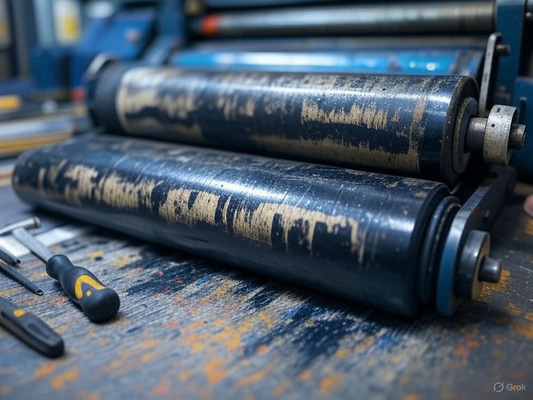
Troubleshooting Guide For Printing Rollers...
The Role Of Printing Rollers In Modern Printing Technology...
Benefits of re-Rubberizing rubber rollers...
Industrial Applications of Conveyor Rollers...

Choosing the Right Rubber Roller for Your Printing Needs...

Maintenance Tips for Long-Lasting Rubber Rollers...