In the world of offset printing, inking rollers (also called ink form rollers, distributor rollers, or simply rubber rollers) play a critical role in transferring ink evenly from the ink duct to the printing plate. The choice between conventional and UV-compatible inking rollers largely depends on the type of ink used: traditional oil-based (conventional) inks that dry through oxidation and absorption, or UV-curable inks that harden instantly under ultraviolet light.
As printing demands evolve—faster turnarounds, vibrant colors on non-porous substrates, and environmental considerations—the debate between these roller types intensifies. This blog dives into the key differences, pros and cons, and practical guidance on when to choose each.
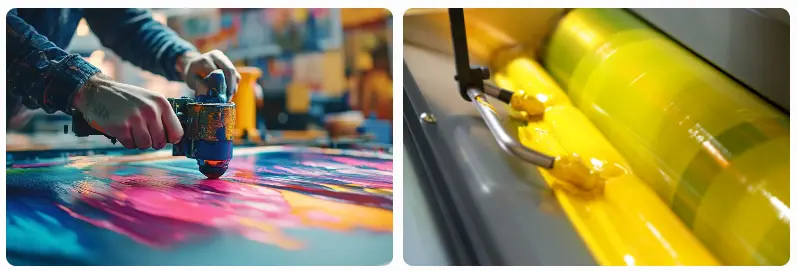
Typically made from nitrile rubber (NBR) or similar compounds, these rollers are optimized for oil-based inks. They have a Shore A hardness of 30–35 degrees, providing excellent ink pickup and release for standard sheetfed or web offset printing.
Designed for UV-curable inks, these often use EPDM (Ethylene Propylene Diene Monomer) rubber, which resists aggressive UV monomers and solvents that cause swelling in conventional compounds. Hardness varies: softer at 25 degrees for some positions and harder at 40–45 degrees for others, to handle higher pressures and heat from UV lamps.
Typical inking roller trains on an offset press—note the multiple rollers ensuring even ink distribution.
| Aspect | Conventional Rollers | UV Rollers |
| Material | Nitrile (NBR) or similar oil-resistant rubber | EPDM or specialized UV-resistant compounds |
| Hardness (Shore A) | 30–35 degrees | 25 degrees (soft) or 40–45 degrees (hard) |
| Ink Compatibility | Oil-based, vegetable/soy inks | UV-curable (full UV, LED-UV, H-UV, hybrid) |
| Swelling/Shrinking | Minimal with conventional inks; vulnerable to UV solvents | High resistance to UV monomers and aggressive washes |
| Heat Generation | Lower; standard operation | Higher due to friction and UV lamps; requires cooling in some cases |
| Cleaning | Standard washes | UV-specific washes; easier with some modern compounds |
| Lifespan | Longer with dedicated conventional use | Longer in UV environments; glazing resistance varies |
| Cost | Generally lower | Higher due to specialized materials |
UV rollers often require dedicated presses or careful conditioning when switching inks, as conventional rollers can swell dramatically in UV environments.
UV curing lamps integrated on an offset press—essential for instant drying but adding heat and requiring compatible rollers.
Print samples comparing UV (left: bolder, glossier) vs. conventional inks—UV often shows richer colors with no absorption loss.
Many printers alternate between conventional and UV jobs without dedicating presses. Hybrid or mixed-mode rollers (e.g., Böttcher’s Chameleon series, Sigma Platina CU, Katsura New UV-X, or Delta Roll compounds) use advanced formulations to handle both ink types without swelling or damage. These are ideal for flexible operations but represent a compromise—slightly reduced performance in pure UV runs compared to dedicated EPDM rollers.
Leading manufacturers like Felix Böttcher (OEM for Heidelberg/Komori, with Chameleon for mixed and dedicated UV compounds), Trelleborg, Sigma Rollers, and Katsura offer excellent options—always test compatibility with your press and inks.
The "best" choice boils down to your substrates, job types, and production goals. UV technology continues to advance (especially LED-UV for lower heat/energy), making it increasingly attractive for modern print shops. However, conventional setups remain reliable and cost-effective for traditional applications.
Consult your roller supplier for samples and press trials—proper maintenance (regular de-glazing, correct storage) extends life regardless of type. What’s your experience with UV vs. conventional? Share in the comments!
View More News